
The decision to fly private extends far beyond the obvious trappings of luxury. For executives managing multinational operations and high-net-worth individuals orchestrating complex travel itineraries, private aviation represents a strategic tool that fundamentally transforms the economics of time. With hourly charter rates ranging from approximately $2,000 for light jets to over $18,000 for ultra-long-range aircraft, the calculus demands careful consideration of access models, aircraft categories, and the emerging sustainability landscape that is reshaping the industry in 2026.
This guide provides a comprehensive framework for evaluating private jet travel—examining not just the experiential benefits, but the technical specifications, cost structures, and operational considerations that distinguish informed clients from casual observers. Whether you are exploring your first charter or optimizing an existing fractional ownership arrangement, the following analysis will equip you with the knowledge to make decisions aligned with your specific travel patterns and priorities.
The Time Value Proposition
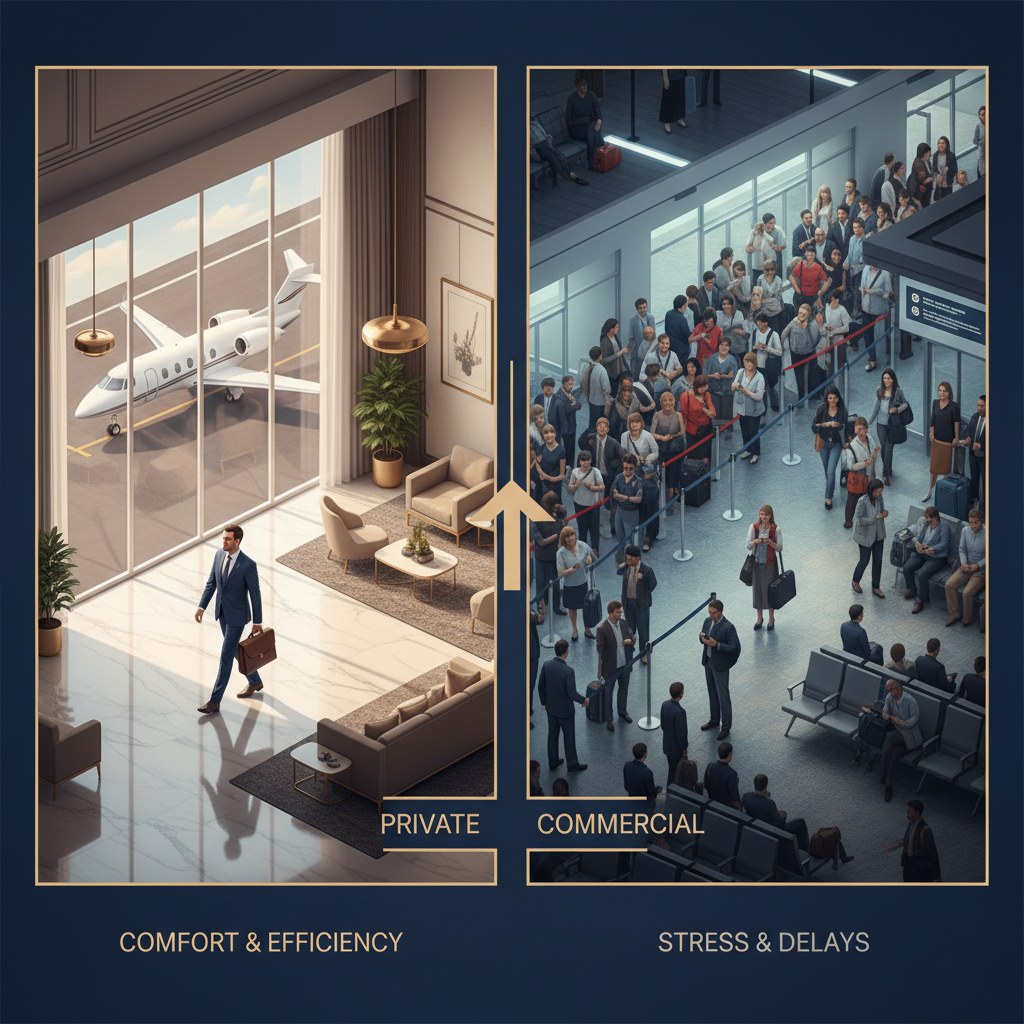
The contrast between private terminal efficiency and commercial airport congestion illustrates the fundamental time advantage
The primary value proposition of private aviation centers on time arbitrage. Passengers can often arrive at the airport just minutes before departure, bypassing the security theater and boarding queues that consume hours in commercial travel. This extends beyond mere convenience—it represents a fundamental restructuring of how travel time integrates with productive work and personal priorities.
Industry experts suggest that productivity on a private jet can reach 30% higher than in a traditional office setting. The controlled environment eliminates interruptions, provides confidential space for sensitive business discussions, and allows travelers to transition directly from meaningful work to arrival at their destination. For executives whose time carries significant opportunity cost, this productivity differential can offset a substantial portion of the charter expense.
The routing flexibility compounds these advantages. Private aviation opens access to over 5,000 airports across the United States alone, compared to approximately 500 served by commercial carriers. This capability proves particularly valuable for reaching manufacturing facilities in secondary markets, resort destinations without major airport infrastructure, or conducting multi-city business trips that would require complex commercial connections. A single-day itinerary visiting three regional offices becomes feasible when freed from hub-and-spoke commercial routing constraints.
Strategic Consideration
When evaluating the economics of private aviation, calculate your effective hourly rate and multiply by the time saved per trip—including reduced airport processing, eliminated connections, and enhanced in-flight productivity. For frequent travelers, this analysis often reveals that private aviation costs less than the opportunity cost of commercial alternatives.
An in-depth exploration of the practical time-saving benefits and productivity advantages of private aviation
Understanding Access Models
The private aviation market offers three primary access structures, each optimized for different usage patterns and commitment levels. Understanding these distinctions is essential for aligning your choice with actual travel behavior rather than aspirational projections.
On-Demand Charter
On-demand charter provides maximum flexibility with no long-term commitment. Clients book flights on a trip-by-trip basis, paying market rates that fluctuate based on demand, aircraft availability, and route specifics. This pay-as-you-go model suits those flying fewer than 50 hours annually or those with unpredictable travel patterns. Charter costs for light jets typically range from $4,000 to $6,000 per hour, including aircraft, pilots, fuel, and standard amenities. However, pricing remains subject to market dynamics—peak season routes or last-minute bookings can command significant premiums.
Jet Cards
Jet cards offer a middle path, providing prepaid flight hours at fixed hourly rates. This structure delivers cost predictability and often includes guaranteed availability windows—typically 24 to 48 hours for domestic flights. Most programs require significant upfront deposits, ranging from $100,000 to $500,000 depending on the card tier and operator. The fixed-rate structure protects against market volatility and simplifies budgeting, making jet cards popular among regular flyers who value consistency over the absolute lowest per-flight cost.
Fractional Ownership
Fractional ownership represents the highest commitment level, where clients purchase a share in a specific aircraft—typically 1/16th to 1/2—granting a proportional number of annual flight hours. This model involves an initial buy-in cost, monthly management fees covering crew, maintenance, and hangar expenses, plus hourly usage fees during actual flights. For those flying 50 to 100 hours annually, fractional ownership can prove more cost-effective than repeated chartering while providing the closest experience to whole aircraft ownership without full operational responsibility.
Average Hourly Costs by Private Jet Service Type (USD)
Hourly costs vary significantly by aircraft class and access model, with heavy jets commanding premium rates for their extended range and cabin space
In 2026, geopolitical factors and potential fuel supply disruptions are anticipated to impact charter prices significantly compared to previous years. Operators are building these uncertainties into their pricing models, making the fixed-rate protection of jet cards and fractional programs increasingly attractive for those who can commit to the required minimums.
A detailed breakdown of the economics behind different private jet access models and when each makes financial sense
Aircraft Selection and Routing Flexibility
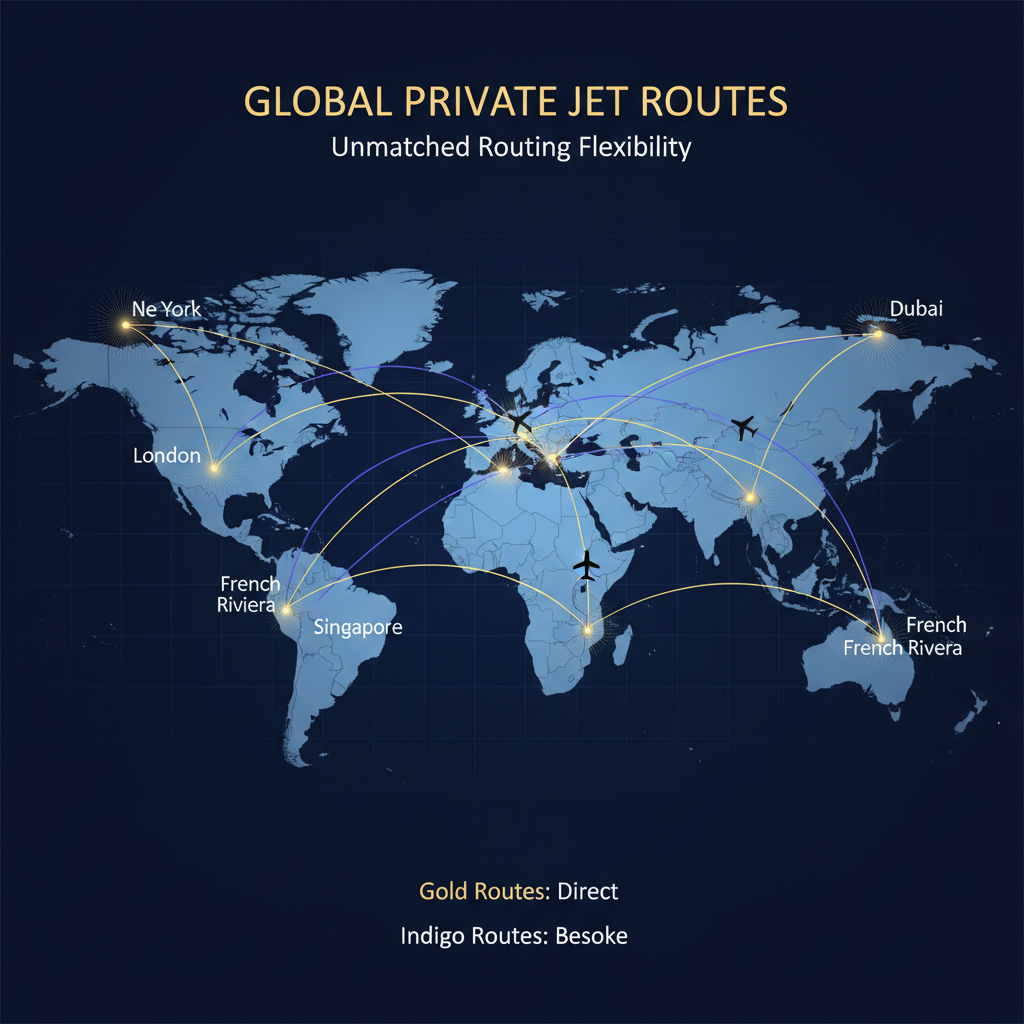
Private aviation opens direct routing options between destinations that commercial carriers simply cannot serve
Aircraft selection directly impacts both capability and cost, with distinct categories serving different mission profiles. Light jets suit shorter regional trips of up to 1,500 nautical miles, carrying four to seven passengers with modest baggage requirements. These aircraft access smaller airports with shorter runways, maximizing routing flexibility for domestic travel.
Midsize and super-midsize jets offer a balance of range and cabin space, typically covering 2,000 to 3,500 nautical miles while providing stand-up cabins and enhanced amenities. These categories serve transcontinental routes and shorter transatlantic crossings, making them popular choices for business travelers requiring both comfort and efficiency.
Heavy jets and ultra-long-range aircraft represent the pinnacle of private aviation capability. Models like the Gulfstream G700 and Bombardier Global 7500 can fly over 7,000 nautical miles non-stop, connecting virtually any two major cities worldwide without refueling. These aircraft feature full-size bedrooms, showers, and conference facilities—essentially flying offices that happen to cross oceans. Hourly rates for ultra-long-range aircraft exceed $18,000, but the ability to conduct a same-day round trip between New York and London transforms previously impossible itineraries into practical options.
Multi-Generational Travel Consideration
For families coordinating multi-generational trips, aircraft selection becomes particularly important. Heavy jets accommodate larger groups while providing separate zones for different activities—grandparents resting while children engage with entertainment systems. The controlled environment also eliminates exposure concerns that might otherwise limit travel for elderly family members or young children.
The routing flexibility of private aviation extends beyond airport access to include timing advantages. Commercial schedules often require overnight stays or inconvenient departure times. Private flights depart when you need them, enabling same-day meetings that would otherwise require multiple nights away from home. For executives managing global operations, this capability transforms the feasibility of maintaining direct oversight across geographically dispersed teams.
Understanding how to match aircraft capabilities with specific travel requirements for optimal efficiency
The Modern Cabin Experience
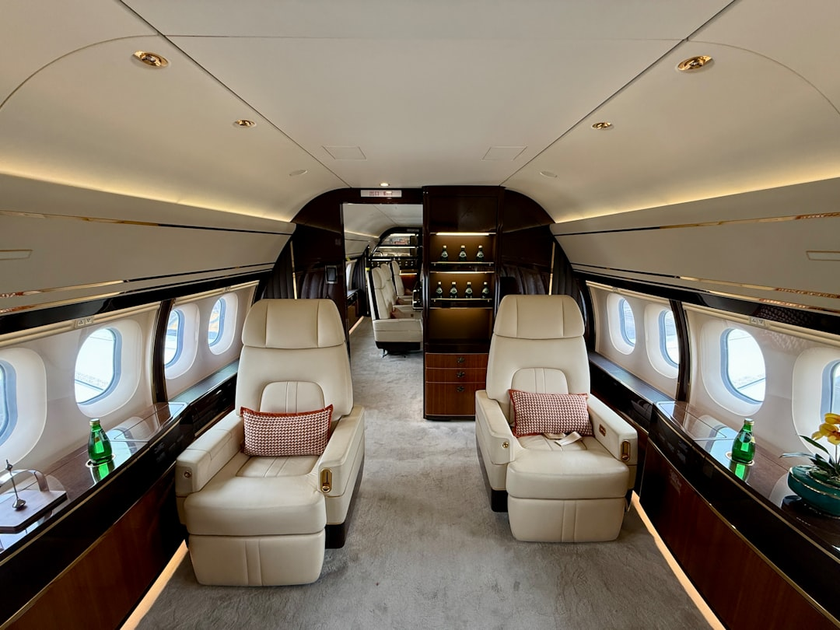
Contemporary private jet interiors blend bespoke craftsmanship with integrated technology for a seamless travel experience
Contemporary private jet interiors have evolved from purely functional spaces into technologically sophisticated environments that reflect individual preferences. The trend toward hyper-personalization means cabin configurations can be specified to accommodate specific workflows—dedicated conference seating for board meetings, private suites for rest during overnight crossings, or entertainment zones for family travel.
High-speed Wi-Fi has become a standard expectation, transforming the aircraft into a fully functional airborne office. Current systems support video conferencing, large file transfers, and real-time collaboration tools at speeds approaching ground-based connections. This connectivity enables executives to maintain full productivity throughout flights that might otherwise represent lost working hours.
The integration of Internet of Things technology is creating what industry observers call smart jets—aircraft where cabin environments can be controlled and personalized with unprecedented precision. Lighting, temperature, entertainment systems, and window shading respond to individual preferences, often learned over time and activated automatically upon boarding. These systems extend to catering, with preferred meals and beverages stocked based on historical preferences and dietary requirements.
Design trends have also been influenced by social media, with the rise of what some call the jetfluencer aesthetic leading to more visually striking and photogenic cabin designs. While this may seem superficial, it reflects a broader recognition that the private jet experience encompasses emotional and aesthetic dimensions beyond pure functionality. For those who view travel as an extension of personal brand, these design considerations carry genuine significance.
Wellness Integration
Leading operators now incorporate wellness features into long-haul flights—circadian lighting systems that help manage jet lag, air filtration that maintains cabin humidity and freshness, and even meditation programs integrated into entertainment systems. For travelers connecting private aviation with luxury wellness retreats, this continuity of wellness focus enhances the overall experience.
An inside look at the amenities and personalization options available in modern private jet cabins
Sustainability Considerations
The environmental impact of private aviation has become impossible to ignore, and the industry is responding with substantive initiatives rather than mere greenwashing. Sustainable Aviation Fuel represents the most significant near-term development, with SAF produced from renewable sources capable of reducing lifecycle carbon emissions by up to 80% compared to conventional jet fuel.
European regulators have begun implementing SAF mandates, requiring increasing percentages of sustainable fuel in aviation operations. While challenges remain regarding widespread availability and cost—SAF currently commands a green premium over conventional fuel—the trajectory is clear. Clients increasingly request SAF for their flights, and operators are building supply chain relationships to meet this demand.
Carbon offsetting programs provide an interim solution, allowing clients to compensate for flight emissions through investments in verified environmental projects. While offsetting has faced criticism as insufficient, reputable programs connected to measurable outcomes—reforestation, renewable energy development, or carbon capture technology—offer a meaningful bridge while SAF infrastructure scales.
Looking further ahead, electric and hybrid-electric private jets are progressing through development and certification. These aircraft promise dramatically reduced emissions and quieter operation, though current battery technology limits range to shorter regional routes. For clients prioritizing environmental responsibility, monitoring these developments and supporting operators committed to early adoption represents an opportunity to align travel choices with values.
Philanthropy Connection
Some high-net-worth travelers are integrating their private aviation usage with broader philanthropic commitments—offsetting emissions through contributions to environmental causes that exceed the carbon footprint of their flights. This approach transforms the sustainability conversation from defensive mitigation to proactive impact, aligning luxury travel with meaningful contribution.
Exploring the future of sustainable private aviation and current initiatives to reduce environmental impact
Booking and Logistics
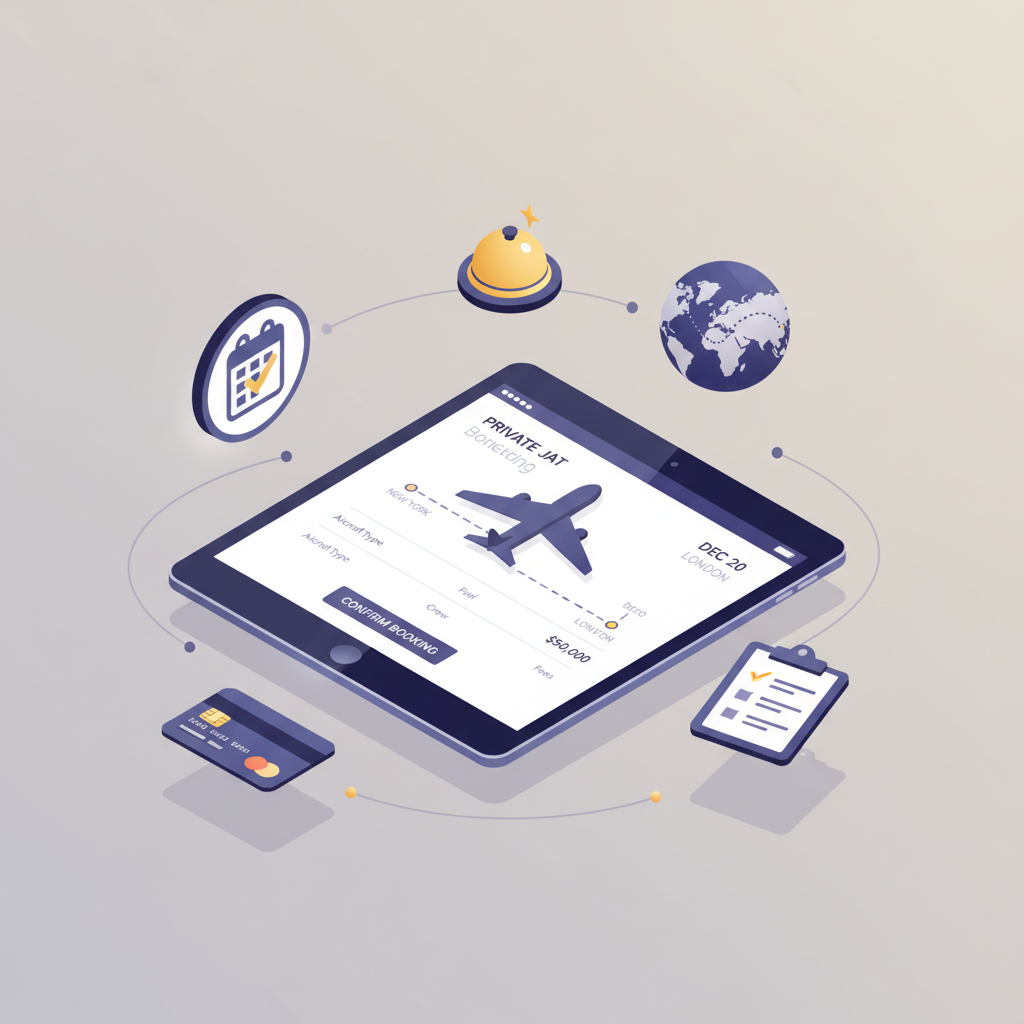
Modern booking platforms integrate flight arrangement with comprehensive concierge services for seamless travel planning
The private aviation booking experience has evolved significantly, with technology platforms streamlining what was once a complex, relationship-dependent process. Modern charter marketplaces provide real-time pricing, aircraft availability, and instant booking capabilities—though the most discerning clients often prefer working with dedicated aviation advisors who understand their specific preferences and can navigate complex multi-leg itineraries.
The integration of concierge services represents a significant trend, with leading operators handling all aspects of travel beyond the flight itself. This includes ground transportation coordination, restaurant reservations, event access, and accommodation arrangements. For travelers seeking seamless end-to-end experiences, these integrated services eliminate the friction of coordinating multiple vendors and ensure consistent quality throughout the journey.
Services like JSX and Aero have introduced a practically private model, allowing passengers to purchase individual seats on jets operating from private terminals. This approach provides many conveniences of private travel—expedited security, comfortable lounges, and departure from less congested facilities—at price points closer to premium commercial fares. For solo travelers or those seeking private terminal convenience without chartering entire aircraft, these services represent an attractive middle ground.
Working with a bespoke travel agency can streamline the private aviation experience, particularly for those new to the market or seeking to optimize existing arrangements. Experienced advisors understand the nuances of different operators, can negotiate favorable terms, and provide objective guidance on access model selection based on actual travel patterns rather than sales-driven recommendations.
Exclusive Event Access
Private aviation often provides the only practical means of accessing exclusive events—art fairs, sporting championships, or cultural festivals in locations with limited commercial service. Coordinating private flights with event logistics requires advance planning, as aircraft availability tightens significantly around major gatherings. Establishing relationships with operators before peak periods ensures access when timing matters most.
For those considering full aircraft ownership, industry experts caution against chartering out privately owned jets to offset costs. While the additional revenue appears attractive, increased wear and depreciation can ultimately prove more expensive than the charter income generates. Ownership decisions should be based on personal usage requirements rather than assumptions about supplemental revenue potential.
Strategic Considerations for Your Aviation Portfolio
Private jet travel represents far more than a luxury indulgence—it constitutes a strategic tool for optimizing the scarcest resource available to high-net-worth individuals: time. The decision framework extends beyond simple cost comparison to encompass productivity gains, routing flexibility, and the intangible value of controlled, predictable travel experiences.
For those flying fewer than 50 hours annually, on-demand charter provides flexibility without commitment. Regular travelers flying 50 to 100 hours should evaluate jet cards for their cost predictability and guaranteed availability. Those exceeding 100 hours merit serious consideration of fractional ownership, while 200+ hour usage patterns may justify full ownership for those prepared to manage the associated operational complexity.
The sustainability imperative will only intensify, making early adoption of SAF and support for green aviation initiatives both environmentally responsible and increasingly expected within sophisticated travel circles. As electric and hybrid aircraft mature, first-mover clients will access capabilities that distinguish their travel programs from less forward-thinking approaches.
Private aviation integrates naturally with other premium travel experiences—connecting seamlessly with luxury yacht charters, private island resorts, and exclusive destination experiences worldwide. The aircraft becomes not merely transportation but an integral component of a curated travel portfolio designed around your specific priorities and preferences.
Begin Your Private Aviation Journey
Explore our comprehensive guides to private travel experiences and discover how to integrate private aviation into your broader luxury travel strategy. From initial charter experiences to sophisticated ownership arrangements, the right approach exists for every travel profile.
Curate Your Perfect ExperienceReferences
- Forbes - Private Aviation Trends and Market Analysis
- Yale - Environmental Impact of Private Aviation
- JetFlo - Private Jet Charter Services and Pricing
- BlackJet - Jet Card Programs and Membership Options
- Airvoir - Aircraft Selection and Specifications
- Econetix - Private Aviation Market Economics
- Charter-A - Sustainable Aviation Fuel Initiatives
Continue Exploring Private Travel Experiences
Discover more exclusive travel options in our Private Travel Experiencescollection, featuring comprehensive guides to yacht charters, bespoke itineraries, and the world's most exclusive destinations.